


Home / News / Civil Engineering
How to choose an AutoCAD training institute in India for job-ready civil engineering certification
Published · CADD Centre Gurugram, Sector 14
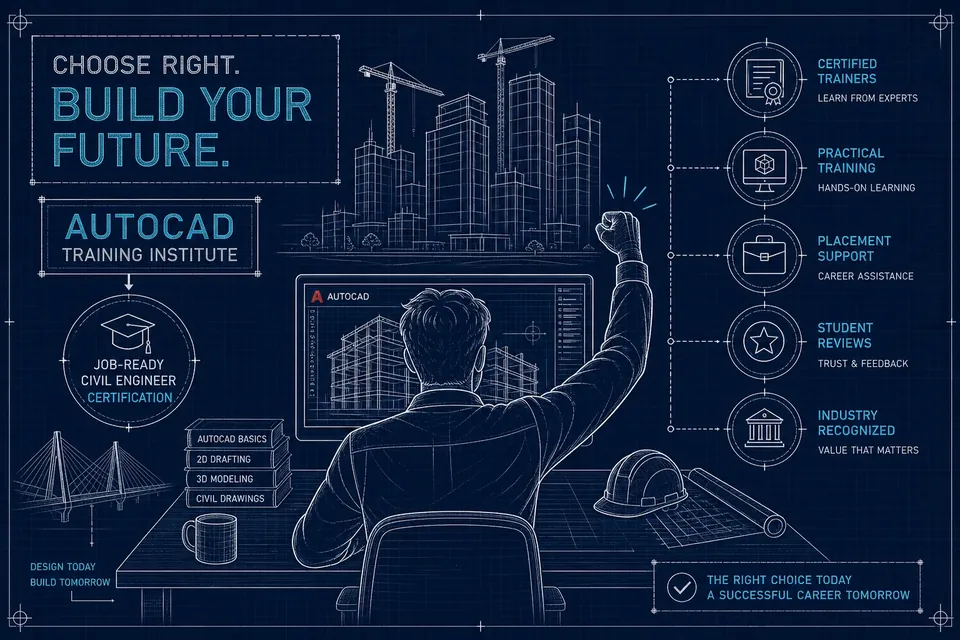
Which AutoCAD training institute in India offers the best job-ready certification for civil engineers? It is the question thousands of civil engineering graduates face each year, yet most course-shoppers ask "which institute is cheapest or nearest?" rather than "which institute makes me genuinely employable?" These are not the same question, and confusing them costs months of time and real money. Many graduates complete a course and still walk into interviews without the skills and portfolio a hiring manager actually wants to see. The problem is rarely the student; it is the institute they chose and why they chose it.
This article reframes that question. It lays out what job-readiness means for a civil drafter, which certification credentials carry real weight with employers, and how to evaluate any AutoCAD training institute before you pay a rupee in fees. By the end, you will have a clear shortlist and the questions to ask before you enrol.
What "job-ready" actually means for a civil engineer
Most AutoCAD courses teach commands. Employers hire people who can produce accurate, standards-compliant, editable civil drawings under deadline pressure. A fresher who can reproduce a course exercise is not the same as one who can set up a site plan with correct layer standards, annotation, coordinate systems and revision marks, and then explain their workflow to a project manager.
Job-readiness for a civil drafter is built on four measurable capabilities. First, proficiency in AutoCAD 2D drafting workflows: layers, blocks, dimensions, layouts, plotting. Second, working knowledge of Civil 3D for surfaces, alignments, profiles and corridor design. Third, a portfolio of at least two or three completed civil drawings, a site plan, road profile or drainage layout, for instance. Fourth, the ability to present and explain those drawings in an interview. An institute that delivers all four is worth shortlisting. One that delivers only the first is not, regardless of what its brochure claims.
The certification credentials that Indian employers actually recognise
Autodesk's own certification pathway is the most portable and employer-legible credential available to AutoCAD trainees in India. The Autodesk Certified User (ACU) exam validates foundational drafting skills and suits freshers targeting junior CAD operator or drafter roles. The Autodesk Certified Professional (ACP) in AutoCAD or Civil 3D carries more weight for design-office and infrastructure positions, particularly with larger consultancies and national firms. When an employer's job listing says "AutoCAD certification preferred," an official Autodesk credential is what they mean, not an institute's certificate of attendance.
The NSDC Civil CAD Designer qualification covers AutoCAD Civil, Civil 3D and InfraWorks within a nationally recognised training framework. At 135 hours, it covers substantial ground and can assist entry-level candidates applying to government-linked projects or firms that recognise the Skill India framework. Training-institute certificates, by contrast, prove course attendance. Their value depends almost entirely on the institute's reputation, the rigour of its assessment, and whether it can connect a candidate directly to hiring employers. Understanding this distinction prevents a common and costly mistake: treating a completion certificate as equivalent to a verified credential.
Which AutoCAD training institute in India offers the best job-ready certification? Five criteria to check first
The single strongest filter when shortlisting a job-ready AutoCAD course is whether the institute holds official Autodesk Authorised Training Centre (ATC) status. This authorisation confirms that the institute's syllabus, instructors and facilities meet Autodesk's own standards. Students trained at an authorised centre are better positioned to sit Autodesk certification exams with confidence, and the credential they earn is verifiable. You can check ATC status directly on the Autodesk website; do not rely on an institute's own claim, logo or an outdated webpage.
Civil 3D syllabus depth
Beyond authorisation, check whether the syllabus covers Civil 3D explicitly: alignments, profiles, surfaces, corridors, grading and pipe networks are the workflows civil engineering employers test for. A course that stops at 2D drafting is a starting point, not a complete job-ready programme. Ask to see the actual module list, not the marketing summary.
Supervised lab time and project deliverables
Classroom instruction without adequate supervised lab time often produces AutoCAD familiarity rather than genuine AutoCAD skill. Look for institutes that provide dedicated workstations, real project briefs and portfolio-ready deliverables that a student actually produces, not downloaded examples or pre-filled templates. Ask directly: "What drawings will I complete during this course, and can I take them away for my portfolio?" A vague answer is itself useful information.
Placement support quality
Several institutes advertise "100% placement assistance" without disclosing an actual placement rate or naming a single employer. Genuine placement support looks different: CV reviews tied to specific civil roles, mock technical interviews that include drawing assessments, portfolio critiques, and direct introductions to hiring companies via a formal industry panel. Before enrolling, ask for the names of employers who have hired from the institute in the past twelve months, and ask whether placement is tracked separately for civil engineering trainees. ACTE is the only institute that publicly quotes a numerical rate, 85%, though this is an overall figure, not civil-engineering-specific.
Instructor credentials and batch size
A fifth criterion that many candidates overlook is instructor background and batch size. Ask whether the faculty have hands-on project experience in civil or infrastructure roles, not simply years of teaching the software. Smaller batches, typically under fifteen students, allow for meaningful feedback on individual drawings and more productive lab sessions. An institute with experienced instructors and manageable batch sizes is far more likely to produce genuinely job-ready graduates than one that prioritises volume.
How top AutoCAD institutes in India compare on those criteria
CADD Centre Gurugram, located in Sector 14, is an Autodesk Authorised Training Centre. This is a concrete, checkable fact that clears the most important hurdle on any shortlist. Its civil engineering programme is reported to cover AutoCAD and Civil 3D workflows through project-based learning, with students working towards portfolio-ready deliverables including highway corridor designs and coordinated models rather than sample exercises. The centre also advertises on-site facilities including a 3D printing lab and a VR/AR design environment, verify these details directly with the admissions team, and ask for a facility walkthrough before enrolling.
Placement support at CADD Centre Gurugram operates through an Industry Recruitment Panel that connects graduates directly to hiring employers, a structured introduction process rather than a job-board listing. The centre advertises this panel, though prospective students should ask specifically for anonymised placement outcomes and employer names from the past twelve months to assess how the process performs for civil engineering roles. For candidates in Delhi NCR evaluating an AutoCAD institute with placement credentials and project-led training, CADD Centre Gurugram merits a shortlist position; verify the specifics directly before committing.
For candidates based outside Delhi NCR, a few options are worth considering. PiperCADD in Chennai publishes a detailed Civil 3D syllabus covering alignments, grading, pipe networks and quantity documentation. Henry Harvin and SevenMentor offer broader AutoCAD civil drafting programmes with project components, though their public syllabi are less specific about named civil deliverables. Across all options, verify current Autodesk ATC status before shortlisting; it remains the most reliable independent quality signal.
For verifying alumni outcomes, CAD Center Hyderabad publishes comparatively detailed public evidence, including information on graduates, employers and project types. Most institutes do not publish this level of detail. When evaluating any programme, ask specifically for alumni names, LinkedIn profiles and employer confirmation. A placement percentage without a methodology behind it is not evidence.
Course duration, fees and what to verify before paying
In Delhi NCR, a job-oriented AutoCAD civil course typically runs six to twelve weeks for 2D drafting, extending to three to four months when Civil 3D and project modules are included, with fees ranging from ₹10,000 to ₹35,000. Chennai and Bangalore providers fall in a similar range, between ₹12,000 and ₹40,000, with durations of two to four months. Kanpur and Kerala tend to be slightly cheaper, between ₹8,000 and ₹25,000, with comparable durations. A comprehensive AutoCAD plus Civil 3D programme with placement support and portfolio review typically lands between ₹20,000 and ₹50,000 nationally. These ranges are based on publicly available fee information from sampled providers in 2026 and should be confirmed directly with each institute.
Online self-paced options are cheaper, often between ₹2,000 and ₹10,000, but they rarely include supervised drafting, portfolio feedback or direct employer introductions. For a civil engineering fresher who needs a job within six months of completing their course, the economics of an unsupported online certificate rarely make sense.
Before paying fees, verify four things in writing:
- Whether the advertised fee includes GST, software access and the certification exam
- Whether Civil 3D is part of the syllabus or a separate paid module
- Whether the institute holds current Autodesk ATC status, checkable on the Autodesk website
- Exactly what placement support involves: who the partner employers are, how introductions happen, and whether the institute tracks outcomes for civil engineering roles specifically
A reputable institute will answer these questions without hesitation.
The portfolio step most candidates skip after completing their course
Certification exams test software knowledge. Hiring managers test whether a candidate can produce usable drawings. The strongest fresher portfolios include at minimum: a fully annotated site plan with correct layer structure; a road or highway profile with alignment and vertical geometry; a drainage or pipe network layout; a grading or earthwork drawing showing cut-and-fill. Each drawing should carry a title block, north arrow, scale bar, revision history and drawing notes. These details distinguish a production drawing from a practice exercise, and experienced recruiters notice the difference immediately.
When a course assigns a real project brief, treat the deliverable as a professional document. Write a one-page workflow summary explaining the design decisions, software tools and standards applied. Export a clean PDF set alongside the working DWG or Civil 3D project file. During an interview, being able to walk through your methodology, not just show a finished sheet, is what separates candidates who completed a course from candidates who learned to think like a drafter. The certificate is the starting line. The portfolio and the practical skill are what get you hired.
Start with the right criteria, not the nearest institute
If you are asking which AutoCAD training institute in India offers the best job-ready certification for civil engineers, the answer depends on a short, verifiable checklist: Autodesk Authorised Training Centre status, a syllabus that includes Civil 3D workflows, real project deliverables you can put in a portfolio, placement support backed by named employers and trackable outcomes, and instructors with genuine industry experience. Institutes that meet all five criteria are uncommon.
CADD Centre Gurugram in Sector 14 merits serious consideration for candidates in Delhi NCR. It holds Autodesk ATC authorisation, offers AutoCAD and Civil 3D training built around project-based learning, and operates an Industry Recruitment Panel connecting graduates to civil and infrastructure employers. Reach out to the admissions team, request a visit or a trial session, ask the hard questions about placement outcomes, and start building your portfolio from day one of your course.
Wherever you are in India, apply these criteria consistently. The right AutoCAD institute with placement support for civil engineering is one that can show you evidence, not just make claims.